
Fry Fortress by Mossback
- Shipping:
- Free Shipping

Quick Navigation: Overview | How It Works | Best Use | How to Use | Limitations | FAQs
Fish Habitat Overview
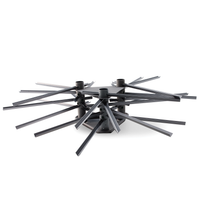
The MossBack Fry Fortress (F2) is a compact, high-density fish habitat system designed specifically to protect fry and juvenile fish in ponds and lakes. This kit includes six 20" trunk sections and a combination of 23" and 60" limb pieces (42 short limbs and 2 long limbs), creating an intentionally tight structure profile that prioritizes small-fish refuge.
Unlike larger predator-focused structures, the Fry Fortress is built to reduce predation pressure during early life stages by increasing protective cover density near the base and throughout the water column.
How This Fish Habitat Works
Newly hatched and juvenile fish are highly vulnerable to predation. Survival during early growth stages directly influences overall fish population balance. The Fry Fortress supports recruitment by:
- Creating tight interstitial spacing: The high limb count produces narrow gaps that small fish can enter while larger predators cannot easily penetrate.
- Providing vertical layering: The 20" trunks and varied limb lengths create usable cover from near-bottom zones upward.
- Reducing open-water exposure: Dense branching limits line-of-sight feeding advantages for predator species.
- Increasing forage survival: Greater juvenile survival can improve long-term fishery structure when integrated into a balanced management plan.
Best Use Cases
- Spawning and nursery zones where fry congregate after hatch.
- Shallow-to-mid depth transitions where juvenile fish seek refuge.
- Ponds with limited vegetation that lack natural nursery habitat.
- Fishery management programs focused on improving recruitment and forage base stability.
How to Use This Product
1) Identify nursery-friendly locations
- Select areas near spawning flats, protected coves, or shoreline zones with reduced wave action.
- Avoid heavy current areas where fry are unlikely to concentrate.
2) Assemble the structure
- Use all six 20" trunk sections and corresponding limb components to build the dense configuration as intended.
- Secure all limbs tightly to maintain spacing and prevent collapse.
3) Deploy with stability in mind
- Lower the unit carefully to maintain upright orientation.
- Confirm manufacturer guidance regarding weighting or anchoring requirements based on your pond bottom type.
4) Distribute strategically
- Multiple smaller nursery structures spaced across spawning areas often provide better coverage than concentrating all habitat in one location.
Limitations & Misuse Scenarios
- Not a substitute for balanced fish populations: Habitat improves survival opportunity but does not correct predator overpopulation or poor stocking ratios.
- Does not improve water quality: Oxygen, nutrient, and algae management must be addressed separately.
- Poor placement reduces benefit: Installing away from spawning zones or nursery areas may limit effectiveness.
- Insufficient distribution: One unit in a large pond may not meaningfully impact overall fry survival.
Frequently Asked Questions
Is the Fry Fortress only for small fish?
It is specifically designed to protect fry and juvenile fish. Larger fish may relate to the structure’s perimeter, but the internal spacing is optimized for smaller fish refuge.
Should this be placed in deep water?
Fry-focused habitat is typically most effective in shallow to mid-depth nursery zones rather than deep basin areas.
How many units should I install?
That depends on pond size, spawning activity, and overall fishery goals. In larger systems, multiple units distributed across nursery zones provide more consistent results.
Will this immediately increase fish numbers?
Habitat improves survival opportunity. Population improvements occur over time and depend on overall fishery balance, forage availability, and predator pressure.
Is this safe for fish?
When properly assembled and installed according to manufacturer guidance, dense habitat structures provide protective refuge without harming fish populations.
Related Products
Related Products
Root Wad Kit by Mossback

Trophy Tree Kit by Mossback

Safe Haven Fish Habitat by Mossback
